
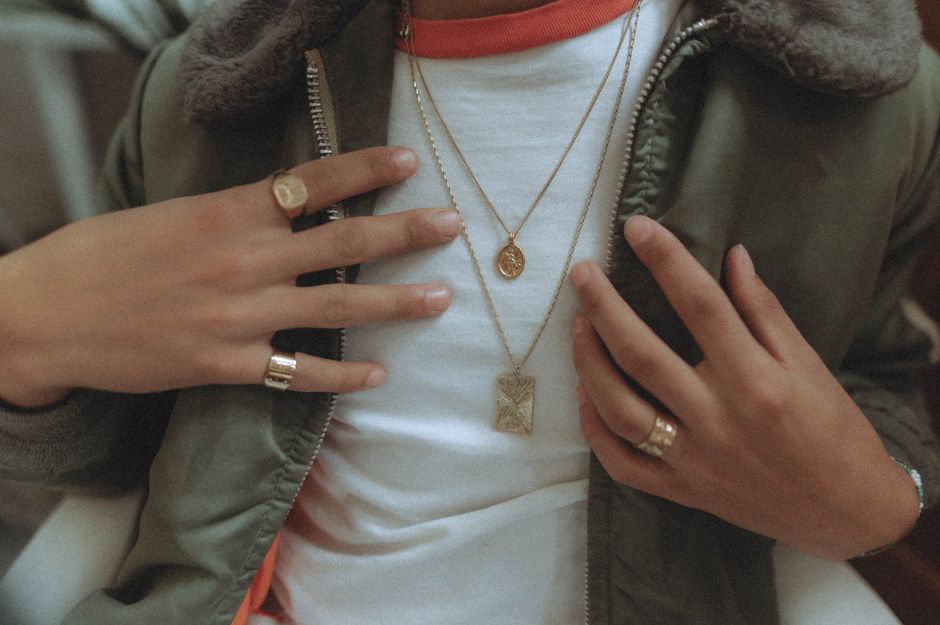
You have a fine chain on, add a pendant, then reach for one more necklace because the outfit still feels unfinished. Five minutes later, every chain sits at the same height, the pendants overlap and the whole stack looks more tangled than styled. Good layering jewellery does not rely on owning a large collection. It relies on spacing, contrast and a clear focal point.
The strongest stacks usually combine three different jobs: one close-to-the-neck anchor, one chain that adds texture and one longer piece that gives the eye somewhere to travel. The prices below are real listed examples from 2026, but stock, currency and promotions can change. Use the measurements as the useful part.
How do you choose necklace lengths for layering?

Start with a tape measure, not a guess. Wrap it around your neck at the height where you want the shortest chain to sit, then add the length of the drop you want below it. Necklace size charts often use total chain length, while your eye notices the distance from your collarbone to the pendant. Those are different measurements.
- Choose the anchor length. Pick 14 to 16 inches for a close collarbone line, 17 to 18 inches for an everyday middle layer, or 20 to 24 inches for a longer pendant. A 15-inch chain can look like a choker on a larger neck, so measure your own fit.
- Leave a useful gap. Add at least 2 inches between fine chains. Use a larger gap when the lower necklace carries a pendant. A 16-inch, 18-inch and 22-inch combination gives clearer separation than 16, 17 and 18 inches.
- Place weight at different heights. Put a small charm high, a medium pendant in the middle or a larger pendant low. Never place two heavy pendants at the same level unless you want them to compete.
- Match the stack to the neckline. Keep the longest piece above the hem of a scoop neck. Let a pendant drop into the open space of a V-neck. Over a high crew neck, use longer chains that sit clearly on the fabric.
- Test the stack while moving. Turn your head, bend forward and walk around. A stack that looks perfect in a mirror may slide into one knot after ten minutes. Move the clasp to different points and check the result.
A practical three-length starting point
For most people, 16, 18 and 22 inches create enough separation without covering the entire chest. Use a 16-inch fine chain as the quiet base, an 18-inch textured chain for interest and a 22-inch pendant as the visual finish. If you have a short neck, move the first layer to 17 or 18 inches and keep the longest necklace around 22 inches.
When adjustable chains help
Adjustable chains suit anyone who changes necklines often. The Missoma Medium Rope Chain Necklace, listed at £98, measures 50 centimetres with an extension range from 46 to 50 centimetres. Its 1.5mm width makes it useful as a middle layer rather than the main statement piece. The adjustable section lets you shorten it above a pendant or lower it beneath a plain chain.
Do not assume an adjustable chain solves every fit problem. The extension itself can become visible at the back, and a heavy pendant can pull the chain towards the shortest setting. Treat adjustability as a styling tool, not a substitute for measuring.
How do you mix metals and pendants?
Should gold and silver jewellery be worn together?
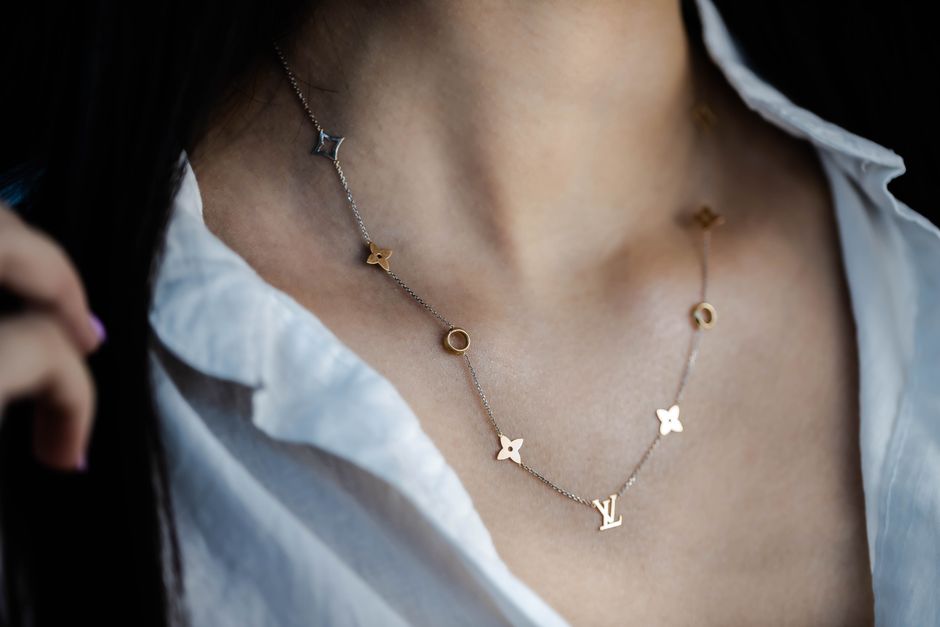
Yes, but give the mix a bridge. Wear one piece that contains both colours, repeat the secondary metal at least twice or keep one metal dominant and let the other act as an accent. A silver pendant on a gold chain can work when the pendant is the only silver element. Add a second silver detail, such as a ring or small charm, and the choice looks deliberate.
Start with a ratio of roughly 70 percent dominant metal to 30 percent accent metal. That ratio stops mixed metals from looking accidental. Warm yellow gold usually feels softer against cream, brown and olive clothing. Silver and platinum tones create a sharper result against black, white, denim and cool grey. These are useful starting points, not skin-tone rules.
How many pendants should one stack contain?
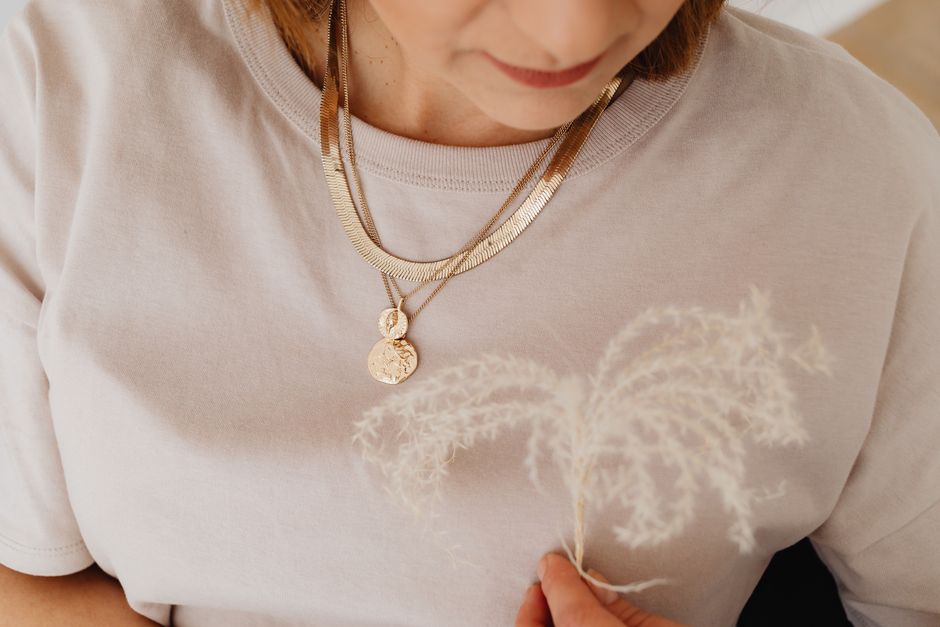
One clear pendant usually gives the strongest result. Two can work if they differ in scale and sit at different lengths. Three pendants often create a crowded centre unless two of them are tiny charms. Place the largest or most meaningful pendant lowest, then keep the higher pieces simple.
The Missoma Heart Talisman Pendant Necklace offers a useful example. It costs $170 on the US listing, uses a 19.6-inch chain adjustable to 18.1 inches, and carries a 20mm by 17.2mm pendant. That size makes it a focal layer rather than a background charm. Put it below a fine 16-inch chain and above a very long, minimal chain if you want three visible levels.
How do you keep the stack from looking busy?
Give one element empty space. If the pendant has a detailed surface, choose a plain chain above it. If the upper layers contain chunky links, use a simple bar or small stone below them. Keep earrings quieter when the necklace stack already has several textures.
Do not mix every sentimental item in one session. A birthstone, initial, coin, heart and zodiac charm may each matter to you, but they do not all need to appear together. Select one story for the outfit and store the rest for another combination. That edit creates more impact than adding another necklace.
What is the best starter stack?
My pick for a first stack is a 16-inch fine chain, an 18-inch textured chain and one 22-inch pendant. This gives you three visible levels, enough contrast to look styled and enough flexibility to wear each piece alone. The strongest starter purchase is not the largest chain. It is the piece that fills the gap between what you already own.
If your jewellery box contains a short fine chain, add a medium rope chain first. The Missoma Medium Rope Chain Necklace is the most versatile example because its 1.5mm width adds texture without taking over. If you already own several delicate necklaces, the Missoma Classic Paperclip Chain Necklace makes more sense as the next purchase. At £98, 5.3mm wide and 50 centimetres long, it gives a light stack a stronger centre.
For a premium, long-term base, the Mejuri Round Box Chain Necklace is the better choice than another plated fashion chain. Its 14k gold construction and 2mm width suit daily wear, but the starting price of $1,200 makes it a poor experiment if you are still learning your preferred lengths. Buy it when you already know that a clean 20- or 22-inch chain belongs in your regular rotation.
The clear verdict: start with the lowest-cost chain that fills a real gap, then spend more on the material you wear most. A $98 textured layer that you use three times a week creates more value than a $1,200 chain that never works with your necklines.
What mistakes ruin a layered necklace stack?
Most bad stacks fail for practical reasons, not because the wearer lacks style. The fix usually involves removing one piece, changing one length or checking the hardware before leaving home.
Too many similar lengths
Chains that sit within 1 centimetre of each other twist, overlap and hide their pendants. Move one piece up or down by at least 3 to 5 centimetres. If the chains cannot separate, wear two instead of three. A smaller stack with clean spacing always looks more intentional than a crowded one.
Too much weight in one place
Several heavy pendants can pull fine chains sideways and place stress on tiny jump rings. Watch for a chain that tilts, a clasp that slides to the front or a pendant that repeatedly flips. Put the heaviest item on a stronger chain and keep delicate chains for light charms.
Ignoring metal care and skin contact
Plated and vermeil jewellery can lose its finish faster when it meets perfume, body oil, chlorine or constant moisture. Apply fragrance first, let it dry and put jewellery on last. Remove necklaces before swimming, showering or sleeping if you want the surface to last longer. Solid gold handles daily contact better, but its higher price does not make it immune to scratches.
Buying a piece that cannot join your wardrobe
Do not buy a necklace only because it looks good in a product photograph. Check its length, link width, clasp size and pendant weight. A 5.3mm paperclip chain may overwhelm a tiny charm, while a 1mm chain may disappear beside a large pendant. Skip a purchase when it repeats a length and texture you already own without adding a useful role.
Before you leave the house, take one photo from a normal standing distance. The camera reveals gaps and overlaps that a close mirror view hides. If the eye lands on one clear focal point and each chain remains visible, the stack is finished.